
 简体中文
简体中文 Français
 لالعربية

SPC flooring is valued for its rigid core and dimensional stability, but gaps, buckling, raised edges and separated joints can still occur. These problems are usually connected to heat, restricted floor movement, unsuitable site conditions, click-lock damage or inconsistent product quality.
For importers, distributors, contractors and commercial project buyers, replacing damaged planks without identifying the underlying cause may provide only a temporary solution. The complete flooring system—including the product, subfloor, installation layout and indoor conditions—should be inspected first.
This guide explains nine common causes of SPC flooring expansion, shrinkage and buckling, along with the practical checks required before installation or corrective work.
Quick Answer: Why Does SPC Flooring Expand, Shrink or Buckle?
SPC flooring normally develops gaps or buckling when the floating floor cannot move correctly, receives excessive localized heat or loses support beneath the click-lock joints.
| Observed Problem | Possible Cause | First Inspection |
|---|---|---|
| Floor lifts or buckles | Restricted expansion or excessive heat | Perimeter clearance and sunlight exposure |
| Gaps between plank ends | Joint damage, movement or temperature change | Click-lock joints and temperature history |
| Raised edges | Uneven support or damaged locking profiles | Subfloor flatness and joint condition |
| Problems near windows | Localized solar heat | Floor-surface temperature and window shading |
| Clicking noise or floor movement | Uneven subfloor or unsuitable underlayment | Support beneath the affected area |
The visible symptom alone does not prove whether the cause is product quality, installation or the site environment. Record the affected area and inspect the complete flooring system before deciding on a repair.
1. Direct Sunlight and High Floor-Surface Temperature
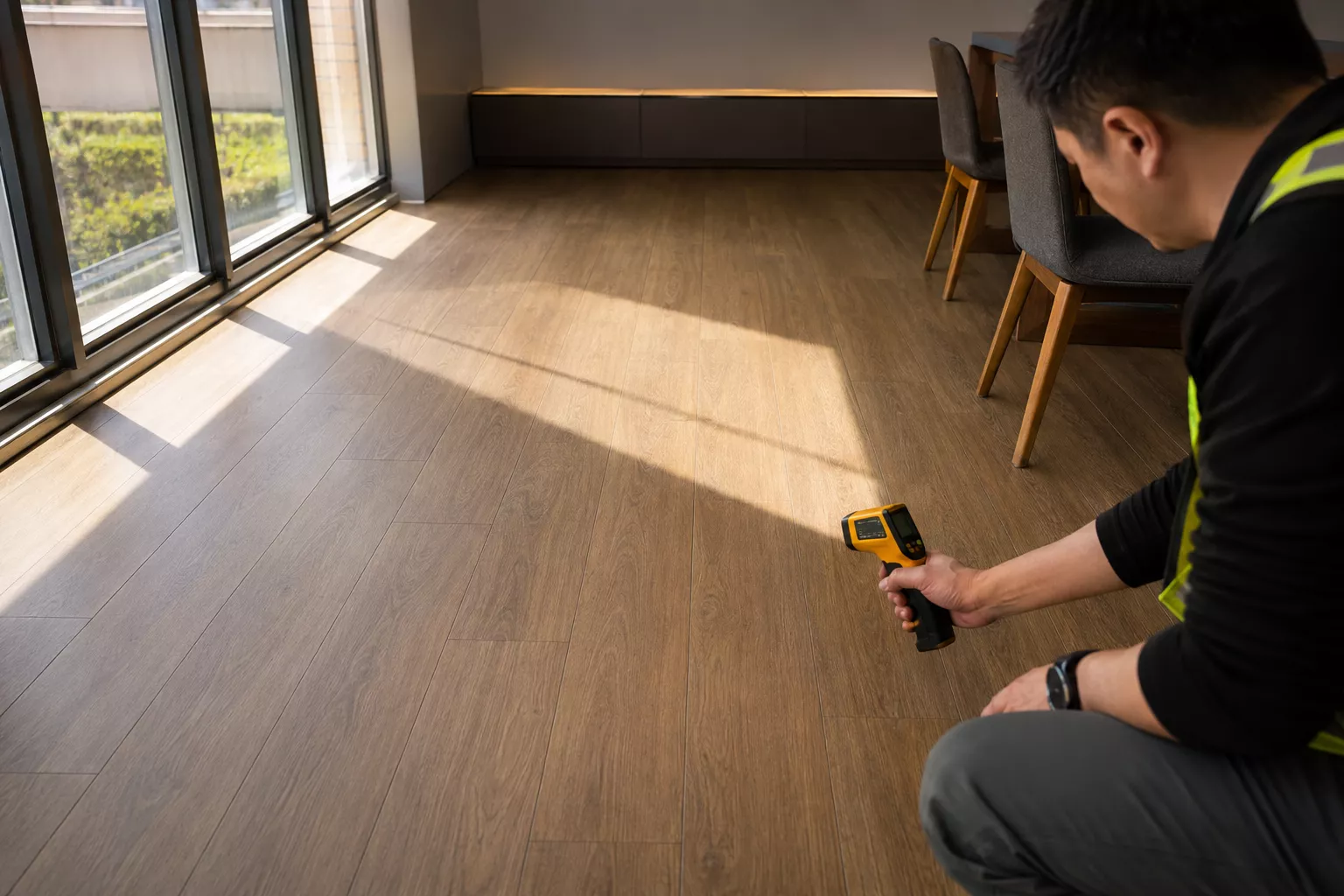
SPC flooring installed beside large windows, glass doors or shopfront glazing can receive concentrated solar heat. The temperature of the sunlit floor may become considerably higher than the surrounding room or shaded areas.
This uneven heating can create movement within the flooring system. If the planks are pressed against walls, thresholds, columns or fixed fixtures, the floor may lift, buckle or place additional stress on the click-lock joints.
Commercial projects with large glazed areas should evaluate:
The direction and duration of direct sunlight
The size and specification of the glazing
Expected floor-surface temperature changes
Window blinds, curtains or solar-control film
Perimeter clearance and transition planning
The flooring manufacturer’s installation instructions
Checking the room temperature alone may not identify localized heat. The floor-surface temperature near windows should also be examined when buckling occurs in a specific area.
2. Insufficient SPC Flooring Expansion Gap
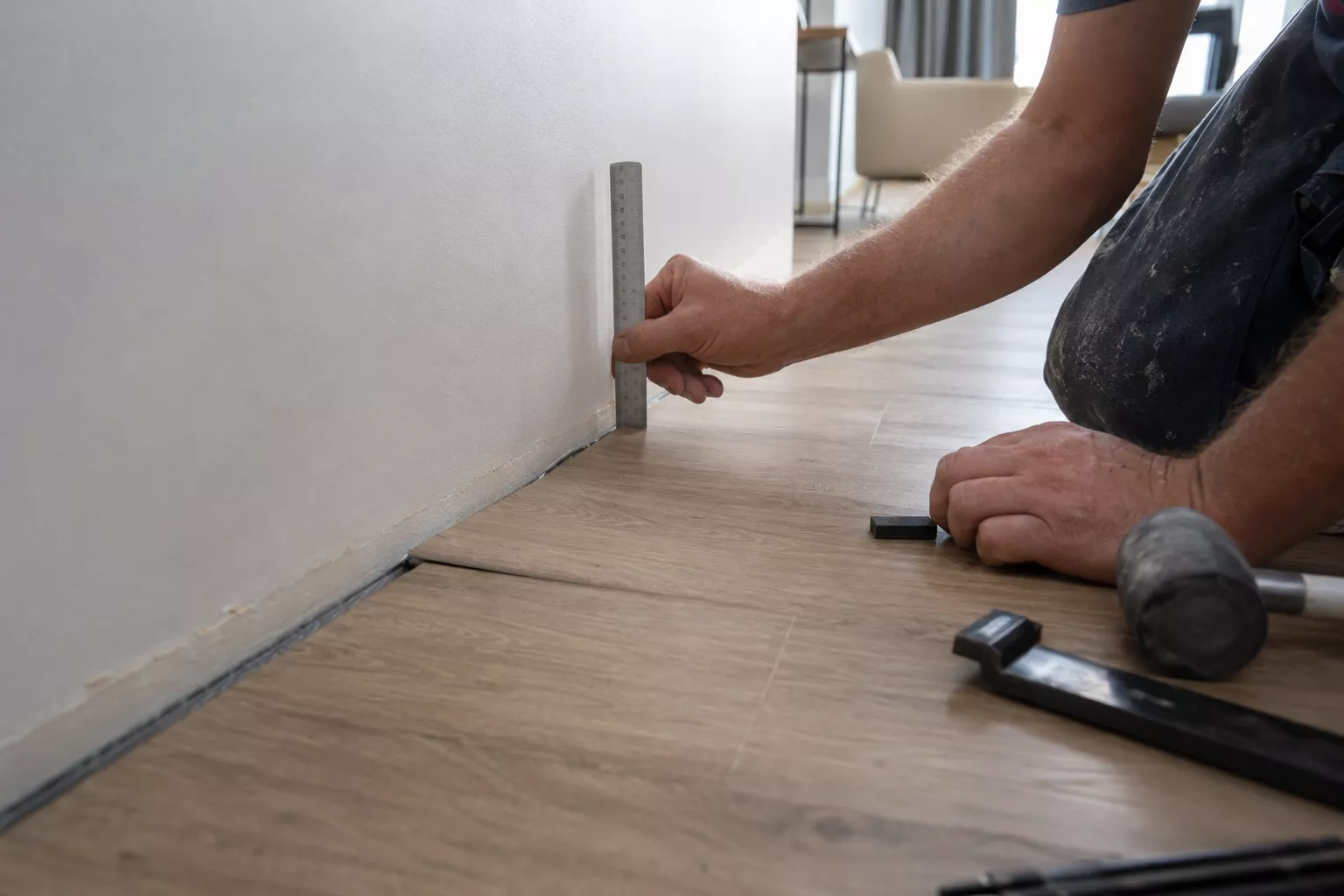
A floating SPC floor needs sufficient clearance around walls and other fixed building elements. The required expansion gap depends on the product, room dimensions, installation layout and manufacturer’s instructions.
Clearance should be checked around:
Walls and skirting
Door frames and thresholds
Columns and floor penetrations
Built-in cabinets and counters
Fixed partitions
Large connected flooring areas
A common problem occurs when clearance is left during installation but later blocked by tight skirting, sealant, screws or fixed fittings. The finished floor must remain able to move according to its installation design.
3. Floating SPC Flooring Trapped by Cabinets or Fixed Fixtures
Floating SPC flooring should not be unintentionally locked in place by permanent cabinets, counters, partitions or other fixed structures. When a large section of flooring is trapped, normal movement may become concentrated in another area and cause lifting or joint separation.
The flooring layout should therefore be coordinated with the cabinet and fit-out plan before installation starts. Contractors should determine where the floating floor will terminate and which fixtures must be installed independently.
Heavy movable furniture is different from a permanently fixed structure. However, concentrated loads and unsuitable furniture feet can still affect the surface or joints and should be considered during project planning.
4. Large Areas Without Suitable Transition Planning
Hotels, offices, schools, retail stores and apartment projects may contain long corridors, connected rooms or large open spaces. Installing one continuous floating floor through a complicated layout may increase stress within the system.
| Planning Item | What to Confirm |
|---|---|
| Installation area | Total length and width of the connected floor |
| Room layout | Doorways, corridors and changes in direction |
| Fixed elements | Columns, cabinets, counters and partitions |
| Temperature zones | Areas with different sunlight or indoor conditions |
| Transitions | Location and specification of transition profiles |
| Installation limits | Current requirements from the flooring manufacturer |
Transition requirements should be confirmed before material cutting begins. Correcting an unsuitable layout after installation is usually more difficult and expensive.
5. Uneven or Unsuitable Subfloor
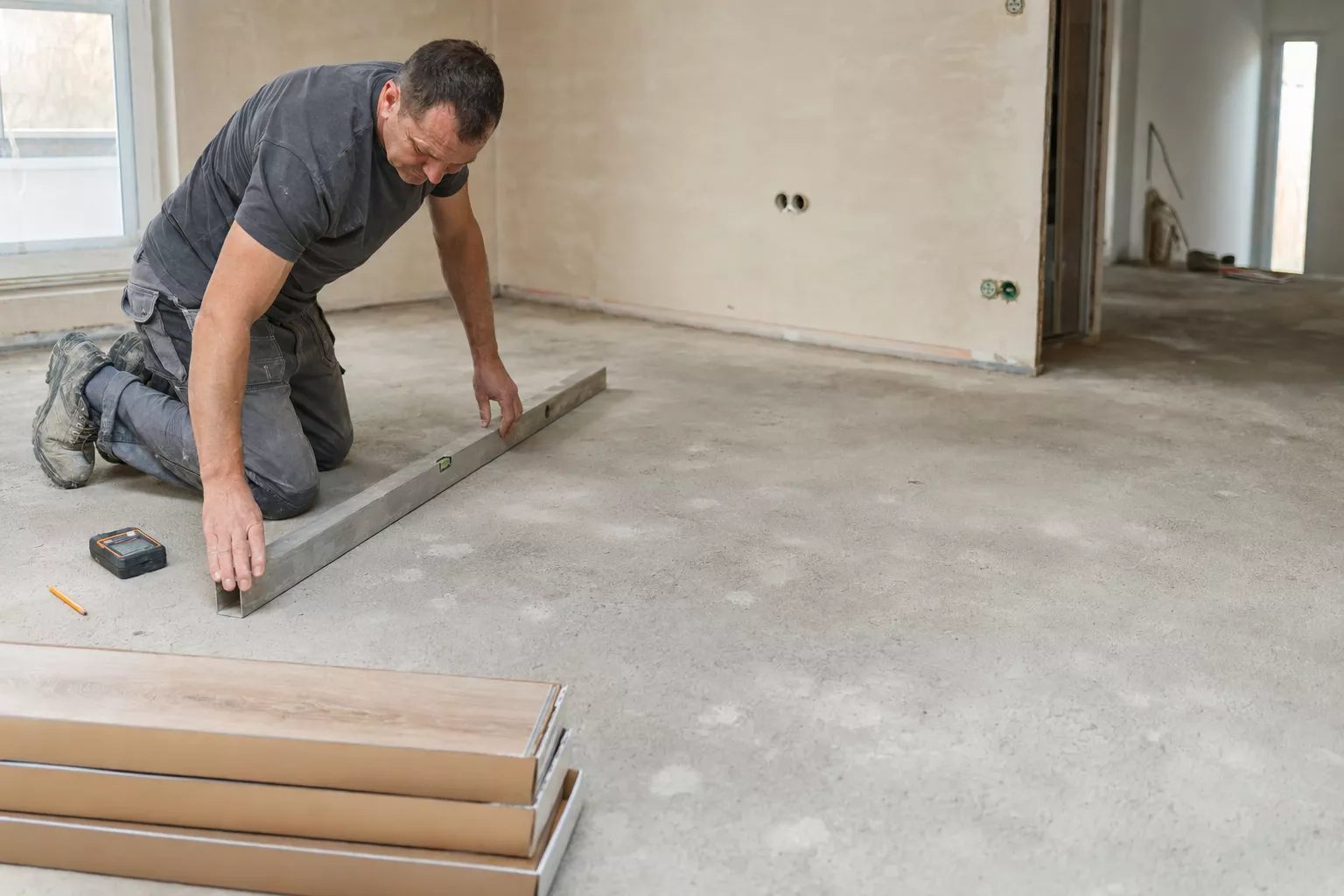
An uneven subfloor does not directly cause every expansion problem, but unsupported areas can move under foot traffic and place repeated stress on the locking joints. This may lead to clicking noise, separated plank ends, raised edges or broken click-lock profiles.
Subfloor inspection should cover:
Flatness across the complete installation area
Local high and low points
Surface strength and cleanliness
Cracks and unstable repairs
Moisture conditions
Debris remaining beneath the flooring
A thicker SPC plank or softer underlayment should not be used as a substitute for proper subfloor preparation.
See our SPC flooring subfloor requirements guide for a more detailed inspection checklist.
6. Moisture and Unsuitable Site Conditions
The SPC core is water-resistant, but this does not mean the complete flooring system can be installed over an actively wet or unprepared surface. Moisture beneath the floor may affect the subfloor, attached backing, separate underlayment or surrounding building materials.
Active leaks, wet screed and unsuitable substrate conditions should be resolved before installation. Moisture testing and acceptance requirements should follow the project specification, local construction practices and flooring manufacturer’s instructions.
Water-resistant flooring and correct site preparation are separate issues. Buyers should avoid treating SPC flooring as a solution for unresolved moisture problems.
7. Incorrect Storage and Site Conditioning
Flooring stored in an extremely hot, cold or exposed location may enter the installation area under conditions that differ significantly from the room environment. Cartons may also become distorted when stored upright or without even support.
Before installation:
Keep cartons flat and properly supported
Protect flooring from weather and direct sunlight
Avoid extreme warehouse and site temperatures
Move the flooring into suitable site conditions
Follow the supplier’s storage and conditioning instructions
Inspect cartons and sample planks before opening the entire order
For export orders, storage should be controlled through factory warehousing, container loading, ocean shipment and destination storage.
8. Damaged or Incorrectly Installed Click-Lock Joints
A visible gap does not always mean the SPC material has shrunk. The locking profile may be damaged, incompletely engaged or repeatedly stressed by movement over an uneven subfloor.
Common click-lock problems include:
Joining planks at an incorrect angle
Using excessive force during installation
Installing planks with damaged locking profiles
Leaving dust or debris inside the joint
Failing to engage the complete plank length
Continuing installation after a joint problem appears
The first completed rows should be inspected carefully. An early alignment error can affect subsequent rows and become harder to correct later.
For additional checks, read our SPC flooring installation mistakes guide.
9. Raw Materials and Production Consistency
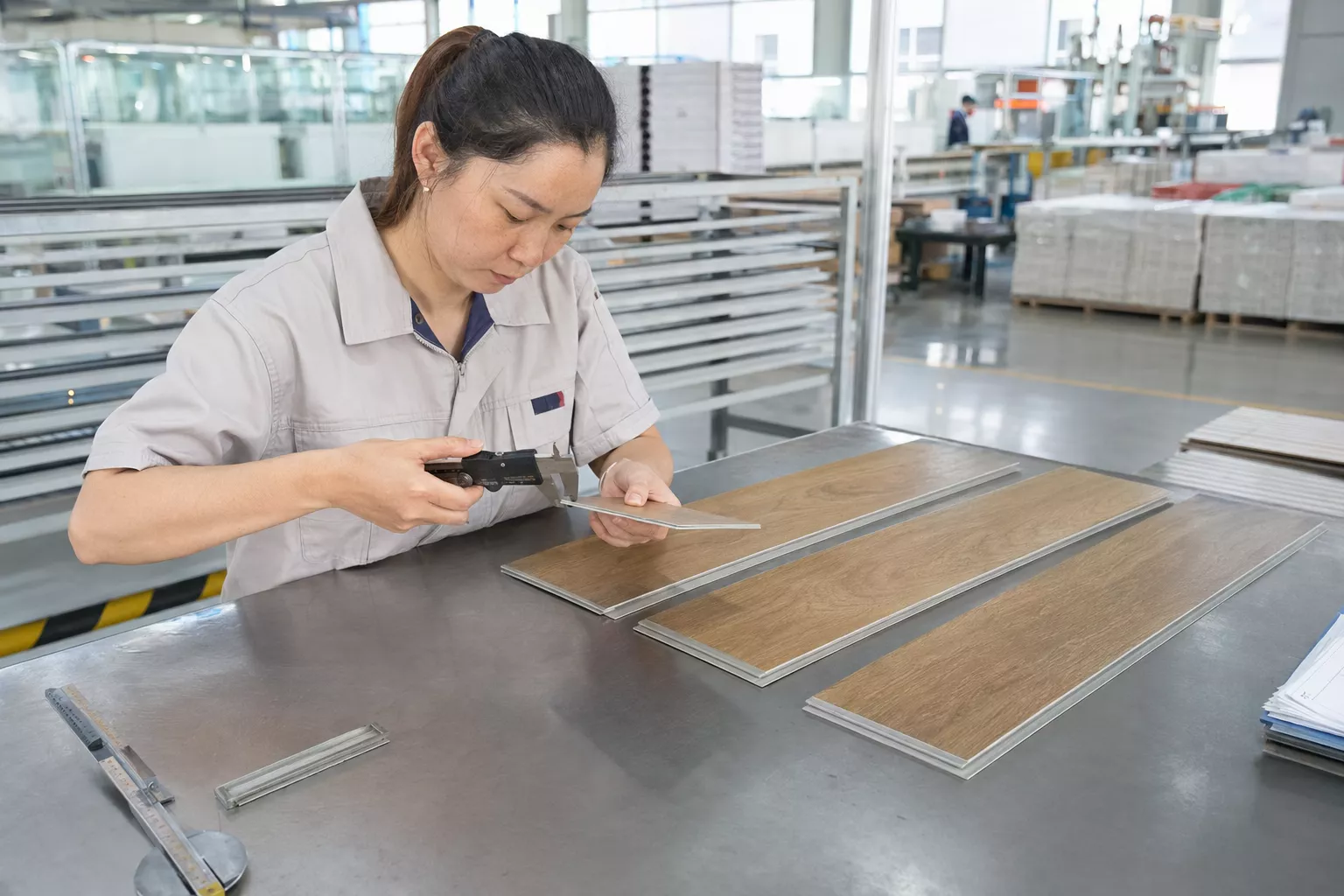
Dimensional stability also depends on the SPC core formulation, raw-material consistency, extrusion control, cooling process and dimensional tolerances. Flooring from different factories—or different quality levels from the same market—should not be assumed to perform identically.
Before approving a bulk order, buyers should confirm:
| Product Item | Required Confirmation |
|---|---|
| Product structure | SPC core, wear layer, decorative film and backing |
| Thickness | Core thickness, backing thickness and total finished thickness |
| Dimensions | Plank length, width and agreed tolerances |
| Locking system | Profile accuracy and joint engagement |
| Approved sample | Color, texture, structure and backing specification |
| Quality control | Inspection method, batch control and required test documents |
The product supplied in bulk should match the approved sample, quotation and purchase specification.
Buyers comparing core formulations can also read our virgin vs recycled SPC flooring quality guide.
How Commercial Buyers Can Reduce SPC Flooring Claims
Preventing complaints requires coordination between the flooring supplier, buyer and installer. Product specifications alone cannot correct unsuitable storage, subfloor or installation conditions.
| Project Stage | Recommended Control |
|---|---|
| Before ordering | Confirm the application, site conditions, plank structure and required documents |
| Before production | Approve the sample and record all product specifications |
| Before installation | Inspect the subfloor, sunlight exposure, layout and transition plan |
| During installation | Check clearance, joint engagement, row alignment and fixed fixtures |
| Before handover | Inspect the finished floor and provide protection and maintenance instructions |
What to Inspect After Gaps or Buckling Appear
Record the site conditions before removing large sections of flooring. Useful evidence includes:
Location and size of the affected area
Photos of the floor, walls, windows and doorways
Room temperature and floor-surface temperature
Direct sunlight exposure during the day
Perimeter clearance after removing the trim
Subfloor flatness and moisture condition
Location of cabinets, partitions and fixed fixtures
Batch numbers, carton labels and remaining samples
Condition of the click-lock profiles
Installation date and the date the problem appeared
This information helps the supplier, installer and project team distinguish between restricted movement, joint damage, product inconsistency and site-related conditions.
Frequently Asked Questions
Does SPC flooring expand in hot weather?
SPC flooring can experience dimensional movement when exposed to heat. The risk increases when strong sunlight creates localized high floor temperatures and the floor cannot move because its perimeter clearance is restricted.
Why is SPC flooring buckling near a window?
Localized solar heat and insufficient movement space are common causes to investigate. Check the surface temperature, perimeter clearance, window shading and whether fixed fixtures are trapping the floor.
Why are gaps appearing between SPC planks?
Possible causes include damaged or incompletely engaged locking joints, temperature changes, an uneven subfloor, installation movement or inconsistent plank dimensions. Inspect the joints and site conditions before assuming that the core has shrunk.
How much expansion gap does SPC flooring need?
The required gap depends on the flooring product, room size, layout and site conditions. Follow the current installation instructions supplied for the specific product instead of applying one measurement to every project.
Can SPC flooring be installed under kitchen cabinets?
A floating SPC floor should not be unintentionally trapped beneath permanent cabinets or fixed structures. Coordinate the flooring layout with the cabinet and fit-out plan before installation.
Can an uneven subfloor cause SPC joints to separate?
Yes. Unsupported sections can move under traffic and place stress on the click-lock joints. The subfloor should be inspected and corrected before installation.
Does thicker SPC flooring expand less?
Not necessarily. Thickness is only one part of the flooring structure. Core formulation, temperature, dimensional accuracy, locking quality and installation conditions also affect performance.
Can additional underlayment prevent SPC flooring gaps?
Not automatically. An unsuitable or excessively soft underlayment may increase movement at the locking joints. Use only an underlayment approved for the flooring system.
See our SPC flooring underlayment guide for more information.
Who is responsible when SPC flooring buckles?
Responsibility cannot be determined from the visible symptom alone. Product quality, storage, temperature, subfloor preparation, layout and installation methods should all be investigated using documented evidence.
Should damaged SPC flooring be replaced immediately?
Identify and correct the underlying cause first. Replacing individual planks without resolving heat exposure, restricted clearance, subfloor movement or locking damage may allow the problem to return.
Request SPC Flooring Specifications and a Factory Quote
For wholesale or commercial projects, send Floren Floor your required thickness, wear layer, backing, plank size, order quantity, application and destination country. We can help confirm the product structure, packing details and suitable sample options before quotation.
A clear specification and documented installation plan can reduce misunderstandings between the supplier, buyer and contractor—and make expansion, buckling and joint complaints easier to prevent.
