
 简体中文
 Français
 لالعربية


An SPC flooring order can arrive with the correct planks but still leave the installer waiting for finishing materials. Missing skirting, an unsuitable doorway profile or a short supply of matching trims can delay an otherwise straightforward project.
For importers, distributors and project buyers, accessories should be specified alongside the flooring. They need their own dimensions, quantities, sample approvals and delivery arrangements.
This guide explains how to prepare an SPC flooring accessories checklist, distinguish common profile types and calculate an order from the actual project layout.
Quick Answer: What Accessories Should an SPC Flooring Order Include?
The required accessories depend on the installation design. Common items include skirting boards, perimeter mouldings, same-height transition profiles, reducers for different floor levels and end profiles. Stair details require a separately approved solution where stairs are included.
Start with the locations that need finishing, then select the appropriate profile and calculate its quantity. Do not assume that one accessory package or a fixed number of metres per square metre will suit every project.
Confirm availability with the supplier before placing the order. Flooring and accessories may have different minimum quantities, packing units and production schedules.
1. Identify the Function Before Choosing the Profile
Accessory names vary between suppliers and markets. A product called a “threshold” or “edge trim” may not have the dimensions or fixing arrangement your installer expects.
Use a drawing, profile reference or physical sample to identify the selected item.
| Accessory | Typical Purpose | What to Confirm |
|---|---|---|
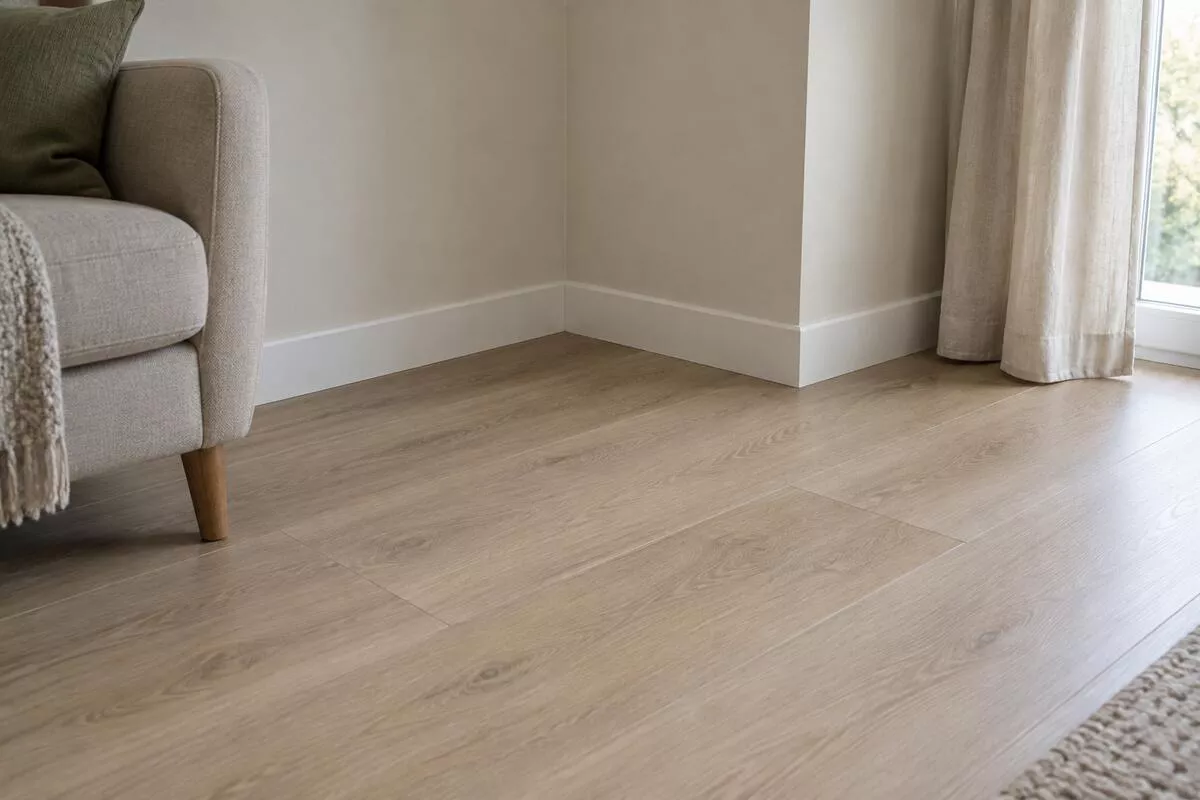
| Skirting / baseboard | Finish the junction between the wall and floor | Height, projection, material, fixing and corner treatment |
| Scotia / perimeter moulding | Provide a perimeter finish where the design retains existing skirting | Coverage, appearance and approved fixing method |
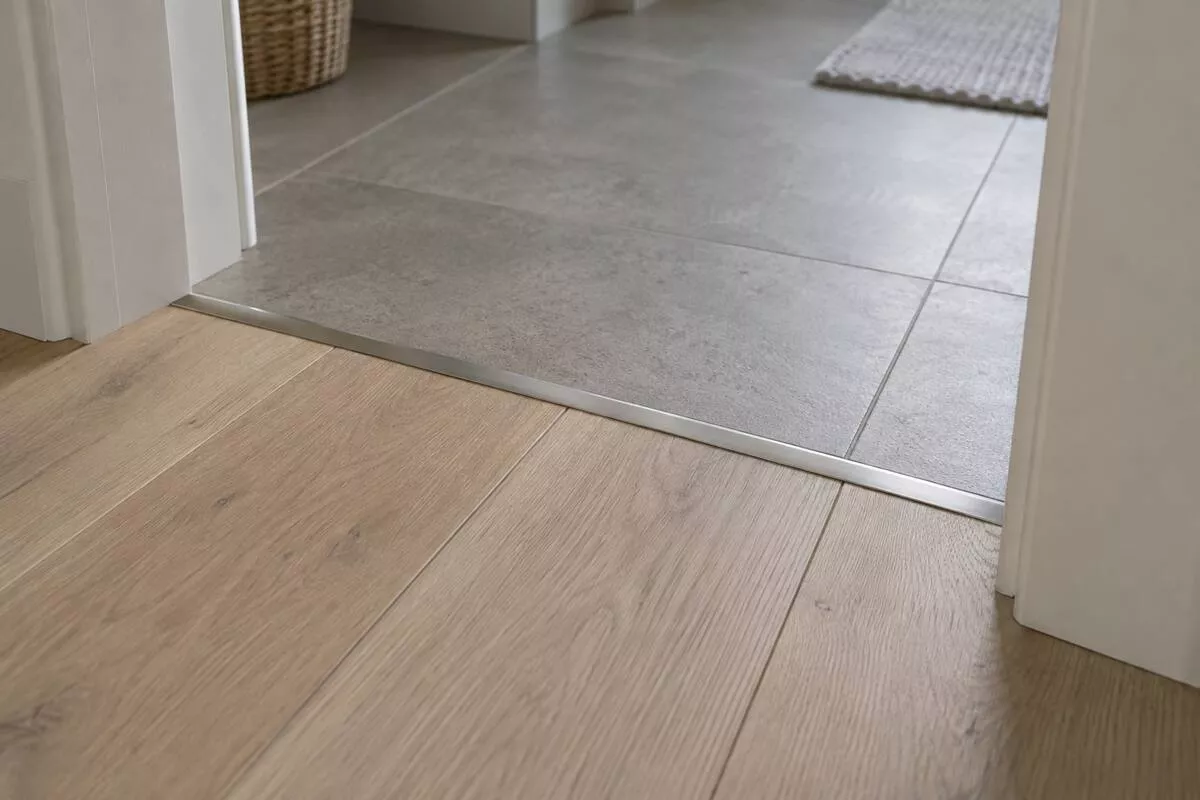
| Same-height transition / T-profile | Cover a junction between floors at similar finished levels | Height range, cover width, movement clearance and track |
| Reducer | Form a transition between different finished floor levels | Actual level difference and suitability for the route |
| End profile / end cap | Finish a termination at a suitable boundary or adjoining material | Edge coverage, floor thickness and installation detail |
| Stair nosing | Finish a stair edge within an approved stair system | Stair compatibility, fixing, profile dimensions and project requirements |
This table identifies common functions, not a universal installation specification. Some multifunctional profiles cover several uses, but only within their stated dimensions and installation instructions.
2. Match Accessories to the Finished Floor Height
A flooring description such as “5 mm SPC” is not enough to select every trim. Establish what the dimension includes and how the complete installation will meet neighbouring surfaces.
Ask the installer to record:
The flooring thickness, including attached backing where applicable.
Any permitted separate underlay.
Changes in substrate level or preparation build-up.
The finished height of adjacent tile, carpet or other flooring.
The clearance beneath doors and around their frames.
The profile’s permitted height range and fixing arrangement.
For example, two flooring materials with similar nominal thicknesses may finish at different levels because their substrates or installation systems differ. Select the transition from the completed build-up rather than comparing product thickness alone.
For preparation questions, review our SPC flooring subfloor requirements guide.
3. Preserve the Movement Space Required by the Flooring System
For a floating installation, the perimeter and transition details must accommodate the movement space specified by the flooring manufacturer. A trim can conceal a gap without eliminating the need for it.
Confirm both the flooring instructions and the accessory instructions. The installer should understand where the base track, adhesive, clips or other fixings belong and how the detail avoids restraining the floating floor.
Do not specify one expansion-gap dimension for every SPC product. Similarly, do not assume that every doorway needs a transition profile, or that all rooms can always be installed continuously. Follow the selected system’s requirements for room layout, installation size and conditions.
Where sealant is proposed, verify the approved detail. It should not be used as an improvised replacement for a required movement arrangement.
4. Approve Colour and Finish with Physical Samples
A trim described as “matching oak” may coordinate with the floor without reproducing its grain, texture and gloss exactly. Accessories can use different materials and surface processes from the planks.
Choose the intended finish deliberately:
A colour-coordinated wood-look profile.
Plain white skirting coordinated with walls or door frames.
A contrasting metal profile selected as part of the interior design.
Compare the actual accessory sample beside the approved flooring under the intended lighting. Record the accessory code, finish, dimensions and approval date.
For repeat projects, retain both samples. A flooring colour reference alone may not identify the accessory that was supplied previously.
Our guide to SPC flooring colour matching from sample to production explains why physical approval references matter.
5. Calculate Quantities from Measured Runs and Cutting Plans
Flooring is usually ordered by area, while many accessories are ordered by linear metre, individual length or pack. Convert those units carefully.
Skirting: Measure the Actual Wall Runs
Measure the wall sections that will receive skirting. Exclude openings and areas where it is not required, and include returns or recesses shown in the design.
Initial length estimate = total required skirting length ÷ usable length per piece, rounded up.
This is a starting estimate. The final order must also account for cutting arrangements, corners, acceptable joint positions and any agreed spare material.
For illustration, 96 linear metres divided by a hypothetical 2.4-metre piece length equals 40 pieces before cutting losses or spares. That calculation alone does not establish that 40 pieces will complete the actual layout.
Doorway Trims: Count Pieces That Can Actually Be Cut
List each opening separately and record its required finished trim length. Then check how those pieces can be cut from the supplier’s stock lengths.
For example, assume ten doorways each require one continuous 0.9-metre trim and the selected stock length is 2.4 metres. Each stock length can provide two doorway pieces, allowing for suitable cutting clearance. Five stock lengths are therefore needed before any additional reserve.
Dividing the combined nine metres by 2.4 and rounding up would suggest four lengths, but four lengths cannot provide ten continuous 0.9-metre pieces. The cutting arrangement matters.
These dimensions are examples only. Use confirmed opening measurements, usable stock lengths and cutting allowances for the actual order.
Count the Supporting Components
Confirm whether each profile includes its base track, connectors, end pieces or clips. Separately count any components that are supplied outside the profile package.
Do not apply a standard waste percentage without reviewing the layout. Keep installation allowances and replacement stock identifiable, as explained in our spare-stock and reorder planning guide.
6. Create an Accessory Schedule for the Purchase Order
Give accessories their own order lines. A note saying “matching trims included” leaves too much uncertainty about what will be delivered.
| Order Field | Information to Record |
|---|---|
| Location and function | Room, opening or wall reference and intended use |
| Product identification | Accessory code, material and drawing or sample reference |
| Dimensions | Length, width, height and compatible floor-height range |
| Appearance | Colour, finish and approved physical sample |
| Quantity and unit | Pieces, metres or packs, with the conversion clearly stated |
| Included components | Tracks, clips, connectors, end pieces and other agreed items |
| Delivery and packaging | Supplier, readiness date, package dimensions and identification |
If flooring and accessories come from different suppliers, assign responsibility for checking compatibility and coordinating delivery. Obtain written confirmation of what each quotation includes.
Use our SPC flooring purchase order checklist to coordinate the accessory schedule with the main flooring specification.
7. Check Packaging and Delivery Before Dispatch
Long accessory packages may require a different handling and packing arrangement from flooring cartons. Confirm their dimensions, protection and loading position with the supplier and freight team.
Before dispatch, check:
Quantities against the approved accessory schedule.
Labels identifying the profile and finish.
Protection for visible surfaces and vulnerable ends.
The location of tracks and small components.
Whether accessories will arrive with the flooring or in a separate delivery.
At site receipt, check the actual profiles against the installation details before work reaches the doorways and perimeter. Discovering a mismatch early leaves more time to resolve it.
Frequently Asked Questions
Are SPC flooring trims universal?
No. Profiles vary in dimensions, compatible floor heights, fixing methods and intended uses. Confirm the exact product rather than relying only on a description such as “SPC trim.”
Can accessory quantities be calculated from flooring area alone?
Not reliably. Skirting depends on wall runs, while doorway profiles depend on the number and width of openings. Cutting arrangements and stock lengths also affect the order.
What is the difference between a transition profile and a reducer?
A same-height transition typically covers a junction between floors at similar finished levels. A reducer accommodates a difference in level within its specified range. Check the selected profile drawing because supplier terminology varies.
Must skirting match the flooring colour?
No. Colour-coordinated, white and contrasting finishes may all be appropriate design choices. Approve the actual sample with the flooring and surrounding finishes.
Does every doorway require a transition strip?
Not necessarily. The requirement depends on the selected flooring system, layout, adjoining materials and installation conditions. Follow the manufacturer’s instructions and the project detail.
Are base tracks and clips included with the trim?
They may be included or supplied separately. Record the package contents in the quotation and purchase order instead of assuming that every component is provided.
Can any stair nosing be used with SPC flooring?
No. Stair applications need a compatible, approved installation detail. Confirm the flooring’s suitability, the nosing design and its fixing requirements before ordering.
Plan Your Flooring and Accessories Together
Preparing an SPC flooring order for distribution or a commercial project? Send Floren Floor your flooring specification, quantity, destination and required delivery schedule. Include any skirting and trim requirements, with drawings or dimensions where available, so the available supply scope and quotation can be confirmed.
